I was lucky enough to see the touring production Hamilton on Friday, June 10. I originally tweeted this out as a big thread, but I decided to repost it here for ease of reading. Some minor spoilers ahead!

The technical elements were spot on. Music, stage, choreography were all excellent. It didn’t feel like a “lesser” rendition of the Broadway recording by any means. The stage at the Queen Elizabeth Theatre might have been a bit smaller than Richard Rogers, but all the stage elements were still there, including the rolling staircase and the ever stunning rotating floor. Seeing it in person really showed the cleverness of the stage design, including the seemingly hidden stairways to allow the players to move off stage to “reappear” in the balcony. The “turntable” floor was just brilliant. Massive kudos to all the cast for making it look effortless. Dancing between to rotating plates like that was incredible.
The lighting was really effective. There was one small miscue with the chair placement for “Dear Theodosia”, which lead the spotlights to being a bit asymmetrical, but that’s such a minor detail. The sound engineering was great. Vocals were clear and easy to hear, with one or two exceptions (although it was likely just me trying to capture everything at once!)
On to the cast! Vancouver has the And Peggy Tour. I’m not going to be comparing the cast performances against the original cast (that’s not fair to anybody), but instead discussing how the characters were played and how it shifted my perception of them. I appreciated that the performers clearly had the freedom to approach the characters in their own way. Paris Nix, for example, wasn’t “playing” Daveed Diggs; he played his own Lafayette and Jefferson. More on that performance later!
There were only three cast substitutions. Alex Dreschke was in for Jacob Burns as the simpering Samuel Seabury and in the ensemble, Jordona Grolnick was in for Hayley Dorling (ensemble), and Milika Cherée played Eliza Hamilton. On Eliza, I overheard another attendee saying that depending on the performer, we were either going to get the sad or angry version. Cherée brought an excellent indignation to the role. You could really feel the frustration and betrayal she felt for always being left helpless by Alexander, especially in “Burn.”
Julius Thomas III’s Alexander Hamilton was youthful and energetic. He skewed more singer than rapper with the character compared to Lin-Manuel Miranda. That exuberance really reminds you of just how out of his depth Alexander is at times—brilliant, but still a newcomer shaking the system.
Donald Webber Jr. was, just as the role is meant to be, show-stealing as Aaron Burr. Incredibly powerful voice, and an absolute presence on the stage. I wish I could have been closer to the stage in order to see his facial cues—but I’m sure they were brilliant.
I was struck by the deep bass of Darnell Abraham, who played George Washington. His voice must have been two octaves lower than Christopher Jackson. Abraham’s timbre brought a different authority, giving the character an almost mythic stature, which is how I think he’s often depicted in other media.
Paris Nix and Rick Negron both played up the respective accents of Lafayette and King George III, so the characters both felt more comical. It didn’t quite leave as much of a psychopathic impression for George, but worked really well for his role as a tension breaker. Nix’s Jefferson also felt more comedic. It gave a much more villainous air to his antagonist role. A Disney villian, almost. This version was less sympathetic when the character does (occasionally) have some good points, but it made Alexander feel even more like “our” guy.
Brandon Louis Armstrong was excellent as Hercules Mulligan/Jame Madison. While perhaps not as gregarious and feisty as Okieriete Onaodowan’s Mulligan, Armstrong’s version left me wanting even more of the character. Armstrong’s Madison felt like more of a toady to Jefferson, rather than a peer. I think this amplified the villainous feeling of the latter too.
Andy Tofa managed to make John Laurens even more reverent towards Alexander. This Laurens felt a bit more of Alexander’s junior, rather than an admiring equal. A bit more like a little brother instead of a best friend with unresolved romantic tension. This youthfulness also extended to Tofa’s Philip Hamilton, although maybe the height difference between Tofa and Julius Thomas III and my own distance from the stage made it easier to see an adult as a nine-year-old in “Take A Break.” (The show also confirmed to me that I should get my eyes checked and may start needing glasses soon, but that’s beside the point.)
The last half of “Blow Us All Away” and “It’s Quiet Uptown” absolutely destroyed me. The feeling of loss, shame and guilt for the death of a being you’ve raised, and that loved and trusted you, was devastating in light of losing Ringo. Tears saturated my mask, and it was all I could do to not audibly weep. It really speaks to what an amazing writer Lin-Manuel is. They’ve always been heart-wrenching songs, but for pieces I’ve listened to dozens of times to still be able to create new emotional connections shows their power. Oof, Lin.
It was an altogether brilliant show. It was moving, and I’d definitely go back to see it again if I had the opportunity. It was also a great reminder to write like I’m running out of time. Huge thank you to all involved!

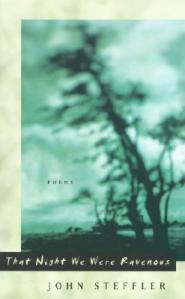 John Steffler’s fourth book of poetry, That Night We Were Ravenous, stands as an excellent example of Steffler’s poetic style. At times comical, and others deeply contemplative (usually a mix of the two), That Night We Were Ravenous often focuses on themes of location, both their natural aspect and the human elements of their constructed identities (perhaps best shown in opposition in the title poem).
 Adrian Southin