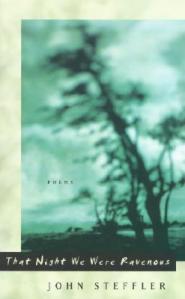
 John Steffler’s fourth book of poetry, That Night We Were Ravenous, stands as an excellent example of Steffler’s poetic style. At times comical, and others deeply contemplative (usually a mix of the two), That Night We Were Ravenous often focuses on themes of location, both their natural aspect and the human elements of their constructed identities (perhaps best shown in opposition in the title poem).
The book opens with this use of the natural world. “Start of a Trail” (no doubt a bout of wordplay on Steffler’s part) is perhaps the most sparse poem in That Night We Were Ravenous, both in language and line construction. What Steffler leaves are strong and sense-focused impressions of the Boreal Forest: “cleft moose print/clusters of rose-purple/cones in the black spruce boughs.”
Steffler’s attention to surprising details comes through in “Cedar Cove” as the speaker learns “the thousand/ways things can be taken/apart and reassigned”. Whether “the boot sole impaled on the shattered/trunk,” or “the rust flakes,/the bone flakes encrusting a bracelet/of kelp”, Steffler creates unique imagery through his use of specificity and unexpectedness. Steffler uses such details to achieve a wide range of effects, from the profound in “At the Pigi Cafe, Ano Potamia” as Steffler describes “The Sun’s white mortar trowelled/on my hand,/the eucalyptus, the pine-slurred/air,/sisters/I’d forgotten I had”, to the (sad) humour of “She was the Prime Minister. She had granted us a tiny/reserve” of “That Night We Were Ravenous” to the outright peculiar end of “Primitive Renaissance”: “Under the table, our starved feet are/pigging the cinnamon dust.”
Another constant in Steffler’s poetry career is his use of conventions of fiction; with rare exceptions of pieces such as “There is Nothing Waiting to Emerge”, the poems of That Night We Were Ravenous are primarily narrative. Steffler makes extensive use of character-based plot, such as the speaker and his companion(s) of title poem “That Night We Were Ravenous” and the run-in with the moose, or the speaker looking for his father in “Wild Pear”. Location is crucial in That Night We Were Ravenous: the hidden coves of Newfoundland in “Cedar Cove” and “How Do We Know This?”, and flying over his home province in “Over Northern Ontario.” These sense of place is not just a setting, but is highly thematic—the poems are grounded and concerned with their location as much as anything else. Even poems that begin as lyric often resolve into use of character and location. For example, “Wind” begins by explaining that “The poem makes itself/when it is ready”, but moves the second half of the poem to the specific location of Filloti, Greece and introduces characters eating lunch.
The form in Steffler’s poems are often “long line, long poem,” but this is never sacrosanct. Short poems are common, as is use of the prose piece. The conversational tone of the prose “Apricots” even borders on dramatic monologue, showing Steffler’s loose approach to genre.
However, Steffler’s attention to narrative and the long line do not diminish his command of poetic language. Density of expression sticks out as a key attribute of That Night We Were Ravenous, as does the use of conceit, both shown in the comparison of the moose to a “a grove of legs startled by pavement” in the title poem. Steffler also strives to a strong sense of musicality through devices like anaphora in “That Night We Were Ravenous” or the use of large spaces between words and in lineation in “Thing Pouring Out.”
With That Night We Were Ravenous, John Steffler has created a book that is just as interested in location as it is the people in it. He commands a contemplative attention with use of specificity, forcing a rumination on the unexpected images he has delivered.

